Summary
"Fractional CTO" has become one of those titles that means everything and nothing. If you're a founder, it's often unclear what you're actually buying, a part-time CTO? a fancy consultant? a cheaper hire? And if you're an experienced engineer, it looks like an appealing way out of full-time employment, but with no real map for how to do it well.
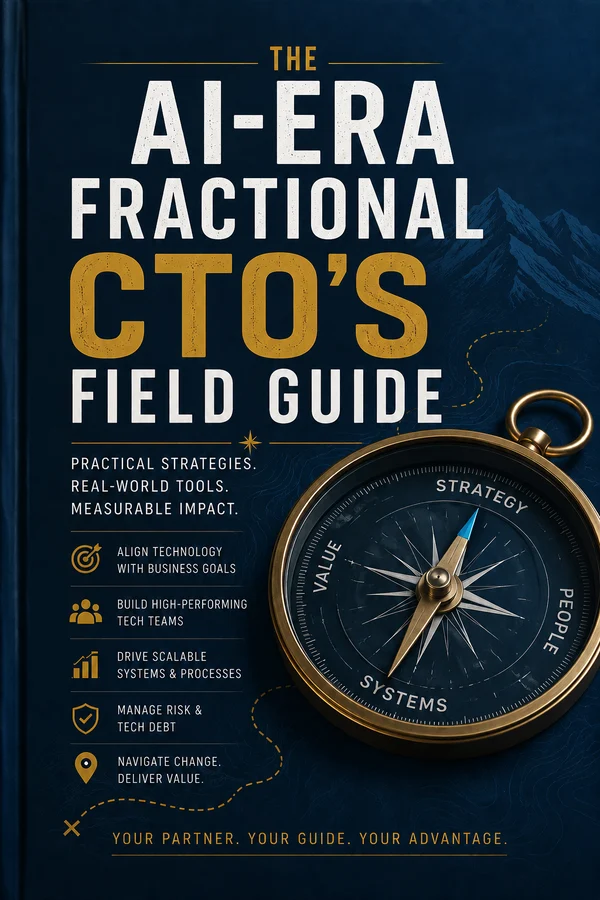
This guide is for both of you, a straight, advisory look at what the role actually is, when a company needs one, what it costs in 2026, and the AI and agentic-team leadership that increasingly defines the job.
What a Fractional CTO Actually Is
Let's start by clearing up the title, because it's doing a lot of confusing work.
A fractional CTO is a senior technical leader who works with a company part-time, on an ongoing basis, and owns the technical leadership a full-time CTO would own (strategy, architecture, the engineering team, vendor and build decisions, the technical roadmap) just at a fraction of the hours and the cost. The key words are leadership and ongoing. That's what separates it from everything it gets confused with.
It is not a contractor. A contractor executes defined work, build this feature, fix this bug, ship this integration. Hands on keyboard, scope closes, done.
It is not a consultant in the drop-in-and-leave sense. A consultant audits, writes recommendations, and hands you a deck. A fractional CTO sticks around and is accountable for whether the recommendations actually happen.
It is not staff augmentation. You're not renting an extra senior developer. You're renting the person who decides what the developers should be doing and why.
And here's the misconception that causes the most grief on both sides: a fractional CTO is not a "cheap CTO." It's a different engagement model, not a discount. You are not buying 40 hours a week at a markdown. You're buying judgment, direction, and accountability, the parts of the CTO job that don't actually require someone to be present 40 hours a week at most companies under a certain size. A good fractional CTO might spend two days a week with you and move the technical needle more than a mediocre full-timer does in five, because the value was never in the hours. It was in the decisions.
The role lives on a spectrum, and it's worth knowing where on it you are:
- Advisory: a strategic sounding board. Light touch, a few hours a week, mostly steering and reviewing. Best when there's a capable team that just needs senior direction.
- Fractional: real, ongoing part-time leadership. Owning the roadmap, making the calls, in the room for the decisions that matter. The classic shape.
- Embedded: deeply involved, near-full-time for a defined stretch. Usually tied to a critical period: a fundraise, a rebuild, a rapid scale-up.
Most of this guide applies across all three. But knowing which one a given situation actually calls for is the first real decision, and it's the subject of the next chapter.
When You Need One, and When You Don't
The honest version of this chapter helps everyone: founders who are trying to figure out if they fit the pattern, and fractional CTOs who need to recognize a good-fit client from a bad one. So here's both, when it makes sense, and when it really doesn't.
When it makes sense
- You're a non-technical founder making technical bets. You're signing contracts with agencies, choosing platforms, and approving architectures you can't fully evaluate. A fractional CTO is the person who keeps you from getting sold something you don't need and translates the technical reality into decisions you can actually make.
- You're a technical founder who's drowning in management. You used to build; now you spend all day in meetings and you can feel the technical direction drifting. A fractional CTO can be the strategic partner who lets you either step back to the code or step up to the business, on purpose instead of by accident.
- Your engineering team has outgrown ad-hoc leadership. Three engineers became eight, there's no process, hiring is chaotic, and architecture decisions get made by whoever's loudest. You need someone to bring order without you having to become that person.
- You're raising, and investors want to see technical leadership. Due diligence is going to probe your tech, your team, and your roadmap. A credible technical leader in the room changes that conversation.
- You're facing a specific, high-stakes transition. A platform migration, a ground-up rebuild, an AI strategy you don't want to fumble, a security or compliance push. These are exactly the moments where senior judgment pays for itself many times over.
- You inherited a mess. A previous team left, the codebase is a mystery, and you need someone to diagnose it honestly and chart a way out.
When it doesn't
This is the part most people selling fractional CTO services won't tell you, so I will.
- You're pre-product and you just need the thing built. If what you actually need is someone to write the MVP, you need a developer or a small agency, not a CTO. Don't pay leadership rates for execution work.
- You're big enough to use a full-time CTO. If there's genuinely five days a week of CTO-level work, hire a full-timer. The fractional model stops saving you money once you're using all of it anyway.
- You only need hands on keyboard. If the work is purely "build this," that's a contractor. A fractional CTO who spends their time coding your backlog is an expensive misuse of the role.
- A board mandate or fundraise narrative requires a named, full-time CTO. Sometimes the requirement is the title in the seat, not the work. Know when that's the real constraint.
The rough rule: the fractional model fits best from "first real engineer" up to somewhere around Series B. Before that you need builders; well past that you need a full-time executive. The sweet spot in the middle is wide, and it's where most companies actually live.
The Engagement Models (and What They Cost)
Let's talk money and structure plainly, because vagueness here is what makes founders distrust the whole category.
The three shapes
Most engagements map to the spectrum from the first chapter:
- Advisory: roughly a day a week or less. Strategic direction, reviews, a sounding board. For teams that can execute but need senior steering.
- Fractional: around two days a week. Real ongoing ownership of the roadmap and the technical calls. The most common shape.
- Embedded: three to four days a week, usually for a defined period tied to something critical.
What it costs in 2026
The market has gotten more transparent, so here are the real ranges. Monthly retainers are where most of this lives, somewhere around 80% of fractional arrangements run on a retainer rather than hourly, and they typically fall between $5,000 and $15,000 a month, with embedded engagements running up toward $25,000. Hourly rates, when used, sit around $150–$350. Here in Canada the retainer range runs roughly CAD $7,000–$15,000 a month. Specialization moves the number: deep AI, fintech, or healthtech experience commands a real premium, often 20–40% over a generalist.
Why retainers dominate: they align incentives. Hourly billing quietly punishes efficiency, the faster and more senior you are, the less you earn for solving the same problem. A retainer pays for outcomes and availability, which is what you actually want from leadership.
The math that makes it work
A full-time CTO costs $250,000–$500,000 a year all-in once you count salary, benefits, and equity. A fractional engagement at $10,000–$12,000 a month is on the order of 60–75% less, with no equity dilution and no severance risk. And the risk math matters as much as the cost math: a bad senior executive hire typically costs two to three times their salary to unwind once you account for lost time, severance, and re-hiring. A six-month fractional engagement is a rounding error against that downside, and a far cheaper way to find out what technical leadership your company actually needs before you commit to a permanent one.
A note for the aspiring fractional CTO
Price the value, not the hours. Structure your offering as tiers (advisory, fractional, embedded) so a client who needs more has somewhere to go and you have an honest upsell path. The single most common pricing mistake is offering one undifferentiated rate, which leaves you nowhere to grow the relationship and tempts you to absorb expanding scope for free. Which is the subject of two chapters from now.
The First 90 Days
The opening stretch of an engagement sets its whole trajectory. Here's what a good one looks like, useful for the fractional CTO running it, and for the founder trying to judge whether it's going well.
Days 1–30: Listen and diagnose
The instinct when you walk in is to start fixing things. Resist it. The first month is for understanding, not changing. That means reading the codebase, yes, but also talking to the team, mapping the infrastructure, understanding the deployment and on-call reality, reviewing the roadmap, and most importantly, understanding the business. What does the company actually need to achieve in the next two quarters? Every technical recommendation that comes later has to ladder up to that, and you can't connect to a goal you haven't heard articulated.
A fractional CTO who starts mandating rewrites in week one, before they understand why things are the way they are, is a red flag. Founders: watch for that.
Days 30–60: Quick wins and the roadmap
Now you've earned the right to act. Two things happen in parallel. First, find a couple of genuinely high-leverage fixes, the kind that demonstrate value quickly and build trust with both the founder and the team. Maybe it's unblocking a painful deploy process, or killing a recurring fire, or making a hire that's been stuck. Second, produce the real deliverable of this phase: a prioritized technical roadmap, written in terms of business outcomes, that everyone can see and agree on.
Days 60–90: Execute and set the rhythm
This is where the engagement settles into its steady state. The architecture decisions start landing. Hiring and process take shape. And critically, you establish the cadence, how you and the founder work together, how often, through what rituals, with what reporting. A fractional CTO is only in the building part-time, so the rhythm of communication is what keeps the relationship from drifting.
What founders should expect
If, by the end of 90 days, you don't have a clear picture of your technical reality, a prioritized plan tied to your business goals, a couple of visible improvements, and a working rhythm with your fractional CTO, something's off. Those four things are the deliverable of a good first quarter. Use them as your scorecard.
Scope: The Thing That Makes or Breaks It
If I had to name the single thing that quietly kills fractional engagements, it's this: unclear scope. It doesn't blow up dramatically. It erodes. A $5,000-a-month advisory engagement slowly becomes a $10,000 hands-on role without anyone deciding it should, and one day everyone's unhappy and no one can quite say why.
So scope deserves its own chapter, because getting it right protects everyone.
Define it up front, explicitly
A good engagement names, in writing, before it starts:
- The deliverables. What is this person actually responsible for producing or owning?
- The cadence. How many days a week or hours a month? Which standing meetings?
- Response-time expectations. Are they reachable for a production fire at 11pm, or is this a business-hours strategic role? Both are fine, but pick one.
- Decision authority. What can they decide on their own, and what comes back to the founder?
- What's explicitly out. The boundary is only real if you've named what's on the other side of it.
Why this matters to founders
Here's the counterintuitive part: a fractional CTO who lets scope quietly balloon is not doing you a favor. It feels generous in the moment. They're just pitching in!, but it means no one is actually steering the engagement, and you're drifting toward paying leadership rates for whatever happens to land on their plate. A leader who protects the scope is protecting your money and your clarity.
Why this matters to the fractional CTO
Your ability to serve several clients well, and to not burn out, depends entirely on the boundary holding. Scope creep in one engagement steals from the others and from you. The professional move when a client's needs genuinely grow isn't to silently absorb the extra work. It's to re-scope explicitly. "What you're describing is really an embedded engagement now; here's what that looks like." Done honestly, that's the upsell path you built into your tiers, and it's better for the client too, because it makes the new reality visible instead of letting it fester as resentment on both sides.
Scope isn't bureaucracy. It's the thing that lets the relationship stay healthy long enough to be valuable.
Speaking in Outcomes, Not Architecture
Here's a skill that matters more than any specific technical decision a fractional CTO will make: the ability to translate technical work into business language. It's the difference between being seen as an expense and being seen as a multiplier.
Consider two ways of reporting the exact same month of work:
"I refactored the API layer and migrated us off the legacy queue."
versus
"I cut our deployment time from two weeks to two days, which means we can now ship fixes to customers the same day they report them, and I dropped our infrastructure bill by about 40%."
The first sentence means nothing to a CEO. It might even sound like you spent a month moving furniture around. The second sentence gets you the next retainer, because it speaks in the only four currencies a founder actually budgets in: revenue, cost, risk, and speed.
Every technical decision can be expressed that way, and a good fractional CTO does it reflexively:
- "This migration" → "removes the thing that's been causing our Friday outages" (risk).
- "This hire" → "lets us ship the enterprise features that are blocking three deals" (revenue).
- "This refactor" → "means new engineers are productive in days instead of weeks" (speed, and therefore cost).
For founders
Use this as a litmus test. A fractional CTO who can only ever explain things in technical terms, who can't or won't connect the work to your business, is a yellow flag, even if they're brilliant. You need a translator at this level, not just an engineer. If you leave every conversation slightly unsure whether the month was well spent, that's information.
For the fractional CTO
This is the habit that compounds. Founders renew, refer, and trust the leader who makes the value legible. You can do genuinely excellent work and still lose the engagement because nobody above you could see it. Don't make them guess. Make the value obvious, in their language, every single time, and the relationship takes care of itself.
The AI-Era Fractional CTO
Here's the thing that's changed the role more than anything in the last couple of years: "help us figure out AI" is now the single most common reason a company brings in a fractional CTO. It's also where the specialization premium lives, deep AI experience reliably commands more than generalist technical leadership, because genuinely knowing what works is still rare.
But here's the uncomfortable truth about what that job actually is, most days: it's protecting the company from the hype.
The data in 2026 is sobering, and a good fractional CTO knows it cold. The large studies keep landing in the same place, the overwhelming majority of corporate AI pilots never reach production or show any measurable impact on the bottom line, and a big share of generative-AI projects get quietly abandoned somewhere after the proof of concept. Meanwhile most small and mid-sized companies adopting AI are doing it with no written policy and no real plan, just a vague sense that they should be doing something.
So the first job of the AI-era fractional CTO is to be the adult in the room. Not the person who says "yes, let's add AI to everything," and not the person who says "AI is a bubble, ignore it", both are lazy. The valuable position is the narrow, honest one: here is specifically where this technology will pay off for your business, here is where it's theater, and here is what it'll take to do the first part well.
The framework I'd hand any founder is simple, and it starts from the opposite end of where most people start. Don't begin with "we should use AI." Begin with a business problem: where is the expensive, repetitive, judgment-light work? Where are people spending hours on things a well-built system could draft? That's where AI creates real leverage, automating the boring 60% so your humans do the 40% that needs them. Starting from the problem instead of the tool is the whole difference between a project that ships and one that joins the abandoned-pilot statistics.
Then there's the unglamorous half nobody puts in the pitch deck: governance. Is the data even ready? What happens when the model is confidently wrong, who catches it, and what does it cost? Who's accountable for an AI decision? What are the compliance and privacy implications? Treating AI output as a first draft that a human owns, never a final answer that ships unseen, is the principle that keeps companies out of trouble. The fractional CTO who skips this part is the one who gets a client into the news for the wrong reasons.
For founders: be wary of the AI cheerleader. Someone who's all enthusiasm and no production scars will cost you more than they save, because they've never had to clean up after a model that misbehaved at scale. You want a leader who has actually shipped AI that real users touch, and who will tell you, plainly, when not to use it. The "no" is often where the real expertise shows.
For the aspiring fractional CTO: this is the highest-leverage specialization you can build right now, full stop. But it only works if it's real. The market is about to be flooded with people who've read about AI; the premium goes to the ones who've built and operated it, who can speak to what breaks and how it's governed, not just what's possible in a demo.
Leading Agentic Teams
If the last chapter was about helping a company adopt AI sanely, this one is about a deeper shift that's reshaping the job itself: the engineering organization is changing shape, and leading it now means leading humans and agents together.
This is more than "developers use AI tools." In 2026 the leading teams are treating AI agents as actual team members, given defined responsibilities, shared context, and a degree of accountability, coordinated through a leadership layer rather than scattered around as isolated assistants. The whole frame has moved from individual productivity ("engineers type faster") to systems ("the org delivers differently").
The consequence for what an engineer does is real. The role is shifting from creator to curator. The valuable engineer spends less time writing foundational code and more time orchestrating a portfolio of agents, designing the overarching system, setting the objectives and guardrails their AI counterparts operate inside, and rigorously validating the output. The operating model the best teams are converging on is three words: delegate, review, own. The scarce skill becomes systems thinking, not syntax.
So what does it mean for a fractional CTO to lead a team like that?
You're designing an operating model, not just an architecture. The new question on the table is: which work goes to agents, which stays with humans, and where exactly does a human stay in the loop? The answer isn't "everywhere" (you lose the leverage) or "nowhere" (you lose the safety). It's a deliberate map where humans own the high-judgment, high-risk, high-context decisions and agents handle the rest under supervision. Drawing that map well is a leadership act, and it's a genuinely new one.
Governance becomes org design. As agents take on real work, the orchestration, approval, and safety that used to be informal team habits have to become explicit structure. The big companies are standing up dedicated platform teams just to manage how agents operate, access data, and get evaluated for safety. A small company doesn't need that machinery, but it needs a lighter version of the same discipline, and figuring out the right-sized version for a given company is exactly the kind of judgment a fractional CTO is there to provide.
Respect the reliability trap. This is where demos go to die. Agents are probabilistic, and reliability compounds badly: a step that works 85% of the time, chained across a ten-step workflow, succeeds end to end only about a fifth of the time. An impressive demo and a system that survives production are separated by exactly the guardrails, checkpoints, and validation that the fractional CTO is responsible for building. And the review function gets more important, not less, AI-generated code carries meaningfully more defects and security issues than human-written code, so "the agent wrote it" is the start of the quality conversation, not the end of it.
Don't outsource mastery. Lean on the tools, absolutely, but a leader who only knows how to operate the agents, without understanding how they actually work, is capped at whatever the tools happen to do and is helpless when they misbehave. The same goes for the team. Part of the job is making sure the org builds real understanding of its agents, not just dependence on them.
And a lot of this is cultural, not technical. Leading an agentic team means moving people from "AI is going to replace us" anxiety to "AI is leverage, and our judgment is the scarce, valuable thing." That's a morale and identity conversation as much as an engineering one, and being honest that the role mix genuinely is changing, while showing people where they remain essential, is part of leading well.
For founders: leading agentic teams is a new skill. A brilliant senior engineer from a few years ago doesn't automatically have it. When you're evaluating someone, ask how they actually run human-plus-agent teams, where they keep humans in the loop, how they handle agent reliability, how they think about governance. Vague enthusiasm isn't an answer.
For the aspiring fractional CTO: this is the frontier of the role, and it's where the position stops being a commodity. Plenty of people will be able to talk about agents. The ones who can design and lead an actual agentic engineering org (operating model, guardrails, governance, and the cultural shift) are the ones who'll command the premium and stay relevant as the easy version of the job gets automated away.
Red Flags: From Both Sides of the Table
A fractional relationship can go wrong from either direction. Here's what each side should watch for, because the best protection against a bad engagement is knowing the warning signs before you sign.
If you're a founder evaluating a fractional CTO
- They can't explain things simply. If everything is jargon and you never come away clearer, that won't improve once they're on the payroll.
- No references, or vague ones. Real engagements leave real, callable references. Ask for them.
- They over-promise availability. Someone claiming deep involvement with six simultaneous clients is doing math that doesn't work. Part-time is real, but there's a limit.
- They push a rebuild before understanding your business. A leader who prescribes before they diagnose is selling you their comfort zone, not your solution.
- Equity-only with no real commitment. Be wary of arrangements where they take a slice of the company but no accountability for outcomes.
- They only ever talk tech, never outcomes. See the previous chapter. This one's a pattern, not a one-off.
- They talk fluently about AI but have never shipped any. In an AI-era engagement especially, watch for someone fluent in the vocabulary (agents, RAG, orchestration, fine-tuning) who can't point to a single AI system they've actually put in front of real users and kept running. The demo is easy and everyone has one. Production scars are the credential. Ask what broke, what it cost, and how they governed it; if there's no real answer, the expertise is borrowed.
If you're a fractional CTO evaluating a client
The table turns, and the same discipline applies to you.
- No clear decision-maker. If you can't tell who actually gets to say yes, your recommendations will die in committee and you'll get blamed for the lack of progress.
- They want a CTO but mean a cheap senior dev. If every conversation drifts toward "can you just build this," the engagement is mis-sold and will sour.
- Unrealistic expectations of part-time availability. A client who treats your two days as if they're five will resent you no matter how much you deliver.
- They won't define scope. If they resist pinning down deliverables and boundaries, the scope creep from two chapters ago is already baked in.
- Chaos with no respect for boundaries. Constant emergencies, weekend "quick questions," no process, a sign the real problem is organizational, and no amount of architecture will fix it.
- They want "AI pixie dust" with no problem to solve. A client who leads with "we need to add AI" instead of a business problem is asking you to build a solution in search of a question, the express lane to an abandoned pilot. If they can't name the expensive, repetitive, judgment-light work that AI would actually relieve, that's a conversation you need to have before you sign, not three months in when the board asks what the AI budget bought.
Notice the symmetry. Most of these are two views of the same failure: a mismatch between what was promised and what's actually needed. Naming the warning signs out loud, on both sides, is how you avoid becoming someone else's cautionary tale.
Making the Relationship Work
You've matched well, scoped clearly, and survived the first 90 days. Here's how to make the engagement genuinely pay off, again, from both sides.
If you're the founder
- Prepare the ground. Give them real access (to the code, the team, the metrics, the context) fast. A fractional CTO operating on partial information makes partial decisions.
- Integrate them, don't hide them. Treat them as a real part of the leadership, visible to the team, not a secret advisor you consult in private. Authority they can't exercise in the open is authority they don't have.
- Give them actual decision power within the scope you agreed. You hired judgment; let it operate.
- Honor the cadence and act on the roadmap. The plan only creates value if you execute it. A roadmap that sits in a doc is just an expensive opinion.
If you're the fractional CTO
- Earn trust fast, then communicate relentlessly. Because you're not always in the building, over-communication is the price of the model. Document decisions so they outlive any single meeting.
- Build the team's capability, not your own indispensability. This is the counterintuitive heart of doing it well: your job is to make yourself replaceable. The engagement that leaves a company dependent on you forever is a soft form of lock-in, and good founders eventually notice. (More on that when we get to the exit.)
- Make the value visible. You can do excellent work and still lose the engagement because nobody above you could see it. Report in outcomes, on a rhythm.
Get these right (preparation and authority on one side, communication and trust-building on the other) and the engagement stops being a series of meetings and becomes an actual partnership. But "making it work" has a few parts nobody warns you about: the team you walk into, the awkward conversation about money, the reality of juggling more than one client, and, done right, how the whole thing ends. Those are the next four chapters.
Working with the Team You Inherit
Almost everything written about fractional CTOs talks about the founder relationship. Far less gets said about the people you'll actually spend your time with: the engineering team that was there before you showed up. Get that relationship wrong and it doesn't matter how good your roadmap is. Nothing in it will happen.
Here's the dynamic nobody says out loud. When a fractional CTO arrives, some of the team hears "the founder thinks we weren't good enough." There may be a senior engineer who quietly wanted that leadership role, or who has been the de facto technical lead and now wonders what you're here to take. Even on a healthy team, a new person with authority over technical direction is a threat until proven otherwise. Pretending that tension isn't there is the fastest way to make it worse.
So the early work with the team is almost entirely about trust, and it looks a lot like the first-90-days posture: listen far more than you prescribe.
Assume the team is smart and the choices were rational. That pile of technical debt usually has a story, a deadline, a pivot, a constraint you don't know about yet. Walk in treating existing decisions as stupid and you'll be right occasionally and resented permanently. Ask why before you judge. Most "bad" code was a reasonable response to a situation you weren't in.
Find the de facto leader and make them more effective, not smaller. If there's a senior engineer who's been holding things together, your job is not to displace them. It's to give them the senior partner and air cover they've been missing. Back them. A lead who feels backed by you becomes your strongest ally; a lead who feels threatened by you becomes a quiet, capable source of friction for the entire engagement.
Credit the team, publicly and specifically. Early wins are almost always partly theirs. Say so. Nothing buys trust faster than a new authority figure who makes the existing team look good to the founder instead of taking the credit.
Don't badmouth your predecessor or the past. It's tempting. It makes you look better by contrast. It also tells everyone watching exactly how you'll talk about them the moment they're not in the room.
For the founder, your part in this matters more than you'd think. Don't spring a fractional CTO on the team as a surprise. Introduce them with clear framing: why they're here, what they own, and crucially that they're here to make the team more effective, not to indict it. Give them visible air cover and real authority. A fractional CTO you've quietly hired but won't publicly back is set up to fail, and you'll have paid for the privilege.
The whole thing comes down to a single message you have to demonstrate, not just assert: I'm here to make this team more effective, not to replace it. Prove that in your first few weeks and the team will run through walls for the roadmap. Fail to, and you'll spend the entire engagement pushing rope.
The Money Question: Equity vs. Cash
Sooner or later the conversation turns to equity, and it's worth having a clear head about it, because this is where both founders and fractional CTOs make avoidable mistakes. (Standard caveat: this is how I think about it, not legal or financial advice. Get a real advisor before you sign anything with equity in it.)
Start from the default: a fractional CTO engagement is a service, and the clean way to pay for a service is cash. A monthly retainer aligns perfectly with the model. You're paying for ongoing senior leadership, you pay for it monthly, and either side can walk with notice. No cap table complications, no valuation arguments, no awkwardness three years later. For most engagements, cash is simply the right answer and you don't need to overthink it.
So when does equity enter the picture? Mainly two situations.
The cash-poor startup you believe in. An early company may genuinely not be able to afford your full rate. A reasonable structure here is discounted cash plus a modest slice of equity. You take some risk alongside them, they conserve runway, and your upside is tied to the thing you're helping build. This can be a good deal for both sides when you actually believe in the company. The key word is plus: equity as a supplement to real (if reduced) cash, not a replacement for it.
The near-cofounder embedded role. Occasionally an embedded engagement is so deep and so early that you're functionally part of the founding technical leadership. That's a different animal, and a larger equity stake can make sense, but be honest with yourself about whether it's still a fractional engagement at that point or whether you've quietly become a part-time cofounder.
The trap, and it cuts both ways, is equity-only for ongoing fractional work. For the fractional CTO: you'd be taking founder-level risk for service-level involvement and service-level control, the worst of both. You don't have a founder's upside, equity, or information, but you're being paid like you do. Decline it. For the founder: paying entirely in equity feels clever (no cash out the door!), but you'll get what you pay for, a part-time advisor with no real skin and no real urgency, and a sliver of your cap table gone for it. If the work is worth doing, it's worth paying for.
A few practical guardrails if equity is in the mix:
- Understand vesting and the cliff. Equity that vests over time, with the standard one-year cliff, protects both sides. It ties the grant to actually sticking around and contributing.
- Know the rough ranges. Advisor-level grants are typically fractions of a percent; a deeply embedded, near-cofounder role is a different and larger conversation. Anchor to what's normal for the actual level of involvement.
- Get it in writing, properly. A real agreement, with real legal review. "We'll sort out the equity later" is how relationships end badly.
- Value your cash rate honestly first. Decide what the engagement is worth in cash, then treat equity as a deliberate trade against part of that, not as a vague bonus that lets everyone avoid naming a number.
The through-line: equity can genuinely align a fractional CTO with a company's success, and in the right situation it's a great structure. But it should be a considered addition to fair compensation, never a substitute for it, and never the thing used to paper over a company that can't, or won't, pay for the leadership it needs.
Running a Portfolio: Juggling Multiple Clients
The whole premise of being a fractional CTO is serving more than one company at once. That's what makes it fractional. But "juggling clients" is a skill nobody teaches, and doing it badly is how you end up underserving everyone and burning out yourself. This chapter is mostly for the practitioner, though if you're a founder, it's also exactly why you should ask a candidate how many clients they carry.
Know your real cap, and be honest about it. There's a hard limit on how many engagements one person can lead well, and it's lower than the math suggests. Two or three meaty fractional engagements is a real load; pile on more and you're not leading any of them, you're just attending their meetings. Lighter advisory engagements take less, so the mix matters more than the count. The number that lets you actually do the job is the number to hold to, not the number that maximizes this month's invoice.
Protect dedicated time per client. The single biggest enemy is context-switching. Bouncing between four companies hour by hour means you're never fully in any of them, and the cost of reloading context every time is enormous and invisible. Block whole days, or at least half-days, per client. "Mondays and Tuesdays are Company A" beats "a bit of everyone every day," every time. Deep work needs uninterrupted runway, and leadership thinking is deep work.
Externalize everything. You cannot hold four companies' architectures, roadmaps, and personalities in your head reliably. Keep a clear, separate written context for each, decisions, status, open threads, the roadmap, who's who. When you sit down for Company A's day, you should be able to reload the full picture in minutes from your notes, not strain to remember where things stood two weeks ago. This is the same context-engineering discipline good agentic work needs, applied to your own brain.
Default to async, reserve sync for what needs it. Living in every client's Slack in real time doesn't scale past one or two. Set the expectation that most communication is asynchronous, with defined response windows, and that synchronous time is the scheduled cadence plus genuine emergencies. This is the same boundary discipline from the scope chapter, here it's what keeps four engagements from each silently expecting all of you.
Plan for collisions. Two clients will eventually have an emergency on the same day. Murphy guarantees it. The way you survive that is having set realistic availability expectations up front (the engagement one-pager again), having built enough team capability at each client that not every fire needs you personally, and being willing to triage honestly, including telling a client "I'm heads-down on a production incident elsewhere today, here's when I can give this real attention." Clients respect honesty about this far more than they respect you quietly doing a worse job for everyone.
Manage your own energy as a resource. Leadership across multiple contexts is cognitively and emotionally expensive in a way hands-on-keyboard work isn't. The portfolio that looks sustainable on a calendar can still grind you down. Build in slack. A burned-out fractional CTO serves no one, and the whole appeal of this model, for you, was supposed to be a better working life, not five jobs stacked in a trench coat.
Done well, a portfolio is genuinely better than a single full-time role: varied problems, diversified income, no single point of failure in your career. Done badly, it's a recipe for serving everyone at 60%. The difference is almost entirely discipline, about your cap, your calendar, your systems, and your boundaries.
The Graceful Exit
Here's the line from earlier in the guide that this whole chapter unpacks: your job is to make yourself replaceable. The best fractional engagements are designed, from day one, to end well, and how you leave is as much a part of doing the job well as anything you do while you're there.
That sounds counterintuitive for someone whose income depends on the retainer continuing. It isn't. A fractional CTO who engineers themselves into being permanently indispensable has built a soft form of lock-in, and good founders eventually feel it, the nagging sense that they can't make a move without you, that the knowledge all lives in your head, that you're less a leader than a dependency. That's not job security. It's a relationship quietly curdling. The fractional CTO who openly works toward their own redundancy is the one who gets the renewal, the referral, and the reputation.
The arc of a good engagement has a natural shape: diagnose, stabilize, build, and then either settle into a lighter steady state or hand off to a full-time hire. Knowing which ending you're heading toward, and saying so out loud, is part of the job.
So what does a graceful exit actually require?
Documentation from day one, not the week you leave. The handoff is the architecture decisions, the roadmap, the "why we did it this way" notes, and the runbooks you've been keeping all along. If those exist, the exit is easy. If they don't, you were building dependency whether you meant to or not.
Know when to call it. Part of doing right by a client is recognizing the moment they've outgrown the fractional model, when there's genuinely five days a week of CTO work, when the company needs a full-time leader in the room every day. The trustworthy move is to name that, even though it ends your retainer. A fractional CTO who tells a founder "you're ready for a full-timer now" is demonstrating exactly the judgment that makes people refer them for the rest of their career.
Hire your own replacement: and onboard them. The strongest possible finish is helping the company find, vet, and bring up to speed the permanent CTO who replaces you. You know what the role needs better than anyone. Running that search, then handing over cleanly to the person you helped choose, is the most trust-building thing you can do in this entire job. It's also the referral engine: founders talk to other founders, and "they even helped us hire their own replacement" is a story that sells itself.
Taper, don't vanish. A good exit is usually a wind-down, not a cliff. Step back to an advisory cadence for a stretch; be reachable for the new hire's questions for a while; let the knowledge transfer actually complete. The relationship doesn't have to end so much as change shape, and a former client who had a clean exit is a lifelong reference and a likely repeat customer when their next company needs you.
For the founder, this is a quiet test worth applying early: a fractional CTO who talks openly about how the engagement will eventually end, and who builds documentation and team capability from the start, is telling you they're optimizing for your success rather than their own retention. That's exactly who you want. Be wary of the opposite, the one around whom everything mysteriously requires their personal involvement forever.
The mark of having done this job well is simple, and it's the note to end on: when you leave, the company is stronger, clearer, and more independent than it was when you arrived. Not more dependent on you. Stronger without you. That's the whole point of the role, and a clean exit is where it gets proven.
Toolkit: The First-90-Days Diagnostic
Everything up to here has been the why and the judgment. The rest of the guide is the toolkit, the templates and checklists I actually use, stripped down so you can lift them straight into your own work. Start here, with the first ninety days, because that's where an engagement is won or lost.
Chapter four described the arc of a first quarter. This is the runnable version: the actual things to look at and ask, grouped so nothing important slips through. Adapt it; don't treat it as gospel. But don't walk in without something like it.
Week 1: Listen before you touch anything
The goal of the first week is understanding, not action. Resist every urge to fix.
The business (most important, most skipped):
- What does the company need to achieve in the next two quarters? In one sentence.
- How does it actually make money, and what's the path to the next milestone (revenue, raise, launch)?
- What's the single thing that, if technology got it wrong, would hurt most?
- Who are the real decision-makers, and how do decisions actually get made here?
The team:
- Who's on it, what are they good at, and what's morale like?
- Where's the knowledge concentrated. I.e. who leaving would hurt?
- Is there a lead already? How do they feel about you arriving? (Answer this honestly and early.)
- What's the hiring situation, open roles, recent departures, gaps?
Weeks 2–4: Audit the reality
Now go wide and write down what you find. A short written audit is the artifact that proves you understood before you prescribed.
Codebase & architecture:
- What's the stack, and is it a deliberate choice or an accident?
- Where's the technical debt that's actually slowing delivery (not just ugly code)?
- How does a change get from a developer's laptop to production? How long does that take?
- What's the test coverage situation, and what breaks most often?
Infrastructure & operations:
- Where does it run, what does it cost, and is anyone watching the bill?
- What's the on-call / incident reality? How often do things break, and who fixes them?
- Backups, monitoring, alerting, present, or theoretical?
Security & compliance:
- How are secrets, credentials, and customer data handled?
- Any obvious exposure, unpatched dependencies, open access, no audit trail?
- What compliance obligations actually apply (and which are being ignored)?
Cost & vendors:
- What's the monthly spend across infra, SaaS, and AI/API usage?
- Which contracts and vendor commitments exist, and are any of them traps?
Weeks 5–8: Quick wins + the roadmap
- Ship two or three high-leverage, visible improvements, things the team and the founder both feel. Unblock the painful deploy. Kill the recurring fire. Make the stuck hire.
- Produce the real deliverable: a prioritized technical roadmap written in business outcomes, not a backlog of refactors. Each item says what it changes for the business (revenue, cost, risk, speed).
Weeks 9–12: Set the rhythm
- Establish the working cadence, standing meetings, a reporting format, decision channels, response-time expectations.
- Land the first structural decisions: a key hire, a process, an architectural call that everything else hangs off.
- Make sure the founder can see the value in their own language. (That's its own chapter.)
The 90-day scorecard
By the end of the first quarter, both sides should be able to point to four things. If you can't, something's off:
- A clear, written picture of the technical reality.
- A prioritized roadmap tied to business goals.
- Two or three visible improvements already shipped.
- A working communication rhythm.
That's the deliverable of a good first 90 days, not a rewrite, not a reorg, but clarity, direction, momentum, and trust.
Toolkit: The Engagement One-Pager
Chapter five argued that unclear scope is the quiet killer of fractional engagements, and that the fix is to write it down before you start. This is what "write it down" actually looks like, a one-page engagement agreement you can fill in together in twenty minutes. It's not a legal contract (get one of those too); it's the shared understanding that keeps the relationship honest.
Copy it, fill the brackets, and revisit it whenever the work changes.
---
Engagement One-Pager
Parties & start date
[Fractional CTO] working with [Company], beginning [date], initial term [e.g. 3 months, renewing monthly].
Tier
[ ] Advisory (~1 day/week) · [ ] Fractional (~2 days/week) · [ ] Embedded (3–4 days/week)
What I own (deliverables & responsibilities)
The specific things this person is accountable for. Be concrete.
- e.g. Technical roadmap and architecture decisions
- e.g. Engineering hiring and team leadership
- e.g. Vendor and infrastructure decisions
- e.g. […]
What's explicitly out of scope
The boundary is only real if you name the other side of it.
- e.g. Day-to-day feature implementation (that's the team / contractors)
- e.g. Non-technical operations
- e.g. […]
Cadence
- Days/hours per week: […]
- Standing meetings: [e.g. weekly leadership sync, biweekly team review]
- Reporting: [format and frequency, e.g. written monthly summary in business terms]
Response-time expectations
Pick one and say it out loud.
- [ ] Business-hours strategic role, not on-call for production fires
- [ ] Reachable for genuine emergencies, defined as […]
- [ ] […]
Decision authority
- Decides independently: [e.g. architecture, tooling, technical hiring shortlists]
- Recommends, founder decides: [e.g. budget above $X, headcount, major vendor commitments]
Compensation & terms
- Retainer: [$X/month] · or hourly: [$X/hr, capped at Y hrs]
- Invoicing: [schedule] · Notice period: [e.g. 30 days either side]
The re-scoping trigger
The most important line, and the one everyone forgets:
"If the work consistently exceeds [the agreed days/hours] for more than [two weeks], we revisit this document and the tier before continuing, not after."
Review date
We revisit this whole page on [date].
---
Two notes on using it. For the founder, this protects your budget: it makes "the engagement quietly doubled" impossible to do by accident. For the fractional CTO, the re-scoping trigger is the single most valuable line you'll ever write. It turns the awkward "I'm doing way more than we agreed" conversation from a confrontation into a clause you both already signed. Scope creep stops being a resentment and becomes a scheduled check-in.
Toolkit: Questions to Ask Before You Sign
The red-flags chapter was about spotting trouble. This is the active version: the questions to ask out loud before you commit, on both sides of the table. Good answers build confidence; evasive ones are information. Ask them directly. Anyone worth working with will respect the diligence.
If you're a founder, ask the candidate
- Walk me through a company like mine you've worked with. What shape was it in when you arrived, and when you left? (Looking for: a real arc, not a highlight reel.)
- What would your first 30 days here look like? (Looking for: listen-and-diagnose, not a rewrite pitched before they've seen the code.)
- Tell me about an engagement that didn't go well. What happened? (Looking for: honesty and self-awareness. "All my clients loved me" is a non-answer.)
- How many clients do you have right now, and how do you keep them from colliding? (Looking for: a real system and an honest cap.)
- Can I talk to two past clients? (Looking for: an immediate yes.)
- How do you decide what to build vs. buy vs. not do at all? (Looking for: business judgment, not a tech preference.)
- Describe an AI system you've put in front of real users. What broke, what did it cost, how did you govern it? (Looking for: production experience, not demo vocabulary.)
- How will you report progress to me, and how will I know it's working? (Looking for: outcomes in my language, on a rhythm.)
- When would you tell me to hire a full-time CTO instead of keeping you? (Looking for: someone who'll do right by you over their own retainer.)
- What do you need from me to be effective? (Looking for: they know access, authority, and decisions matter, and they'll ask for them.)
If you're a fractional CTO, ask the client
- What are you actually trying to achieve in the next two quarters? (Looking for: a clear goal, not "we need a CTO.")
- Who makes the final call on technical and budget decisions? (Looking for: one identifiable decision-maker.)
- What's prompting this now: why a fractional CTO, why today? (Looking for: a real trigger you can actually address.)
- What does success look like to you in six months, concretely? (Looking for: something measurable you can be judged against fairly.)
- How much of my week do you imagine needing, honestly? (Looking for: alignment between their expectation and the tier they're paying for.)
- Walk me through how decisions get made and how the team works today. (Looking for: whether recommendations will actually get executed.)
- What's happened with previous technical leaders or agencies here? (Looking for: patterns, churn, unrealistic expectations, no follow-through.)
- If you say "we need AI," what's the underlying business problem? (Looking for: a real problem, not pixie dust.)
- What decisions are you comfortable letting me make on my own? (Looking for: enough authority to be effective.)
- What's the budget, and who controls it? (Looking for: a real budget and a clear owner, ask early, not last.)
The symmetry is the point. The same engagement that's wrong for a founder is usually wrong for the CTO too, and both lists are really probing one thing: is there a clear goal, real authority, and honest alignment about what this is? If the answers line up, you've got the makings of a good engagement. If they squirm, you found out for the price of a conversation instead of a quarter.
Toolkit: The AI-Readiness Assessment
The AI-Era chapter argued that the fractional CTO's first AI job is to be the adult in the room, to find where AI actually pays off and steer around the hype that abandons most pilots. This is the tool for doing that: a readiness assessment you can run on a company in an afternoon, before anyone writes a line of code or signs a vendor.
Score each item 1 (not at all) to 5 (absolutely). It's diagnostic, not arithmetic, but the pattern of low scores tells you exactly where the project will fail if you proceed anyway.
1. Problem clarity
- We can name a specific, expensive, repetitive task AI would relieve, not "we should use AI."
- We can describe what success looks like in a number (hours saved, cost cut, throughput up).
- A human does this task today, so we have something to measure AI against.
If this section scores low, stop here. A solution in search of a problem is the single most common way AI projects die. No amount of model quality fixes a missing problem.
2. Data readiness
- The data the AI would need exists, and we can actually access it.
- It's reasonably clean, current, and in one place, or we know the work to get it there.
- We're allowed to use it this way (privacy, consent, contracts, residency).
Low scores here mean the real project is a data project first. That's fine, but it has to be named and budgeted, not discovered in month two.
3. Where the leverage actually is
- The target work is high-volume and judgment-light (great fit) rather than rare and high-stakes (poor fit).
- A good-enough-but-imperfect answer is still useful here. We don't need 100% accuracy to get value.
- The output is a first draft a human reviews, not a final decision that ships unseen.
This is where you separate real leverage from theater. AI shines on the boring 60%; it's dangerous where errors are rare, costly, and unreviewed.
4. Governance & accountability
- We know who is accountable when the model is wrong, and what the fallback is.
- We have (or will write) a basic AI usage policy, what's allowed, what isn't, who approves.
- We've thought about the failure modes: confident wrong answers, data leakage, biased output.
- There's a human in the loop wherever the decision carries real risk.
Most small companies score near zero here, and don't realize it's a problem until it is. This section is where a fractional CTO earns the retainer.
5. Team & operating capability
- Someone can actually own this system after it's built. It won't be orphaned.
- The team understands the tools well enough to supervise them, not just run them.
- We can monitor it in production and tell whether it's still working.
Low scores mean you're building something that rots the day you leave. Build capability alongside the system, or don't build it.
6. Expectations & economics
- Leadership understands AI augments and accelerates. It isn't magic and isn't free.
- We've budgeted for the ongoing cost (tokens/compute, monitoring, maintenance), not just the build.
- We're prepared for this to be iterative, a first version that improves, not a one-shot miracle.
Misaligned expectations sink more AI projects than bad technology does.
Reading the result
You're not adding up a grand total. You're looking at the shape:
- Section 1 (problem) low → don't start. Go find a real problem first.
- Section 2 (data) low → it's a data project before it's an AI project. Scope that honestly.
- Section 4 (governance) low but everything else solid → the most common real situation. Proceed, but governance is the first deliverable, not an afterthought.
- Mostly 4s and 5s → genuine readiness. Now you can talk about models, tools, and timelines.
The value of running this is the honest, structured conversation you'll have about whether this AI project should exist before anyone's emotionally or financially committed to it, which is exactly the conversation that separates the projects that ship from the 95% that quietly don't.
About Roger
I'm Roger Stringer. I build things, break them, and write up what I learned so you don't have to learn it the hard way. These Field Guides come straight out of that work.
Working on something bigger? I work as a fractional CTO through [Data McFly](https://datamcfly.com), helping founders and teams set technical direction, build AI-powered workflows, and actually ship the hard parts. Here's how my engagements actually work. Not sure if it's a fit? Book a free 30-minute call. No pitch, no pressure, and if it's not the right move I'll tell you that too.
And if a guide helped, got something wrong, or you just want to compare notes, I'd love to hear from you:
- Email: roger.stringer@hey.com
- X: @freekrai
- GitHub: github.com/freekrai
- LinkedIn: linkedin.com/in/rogerstringer
New guides go up as I hit problems worth documenting. Follow along wherever suits you.